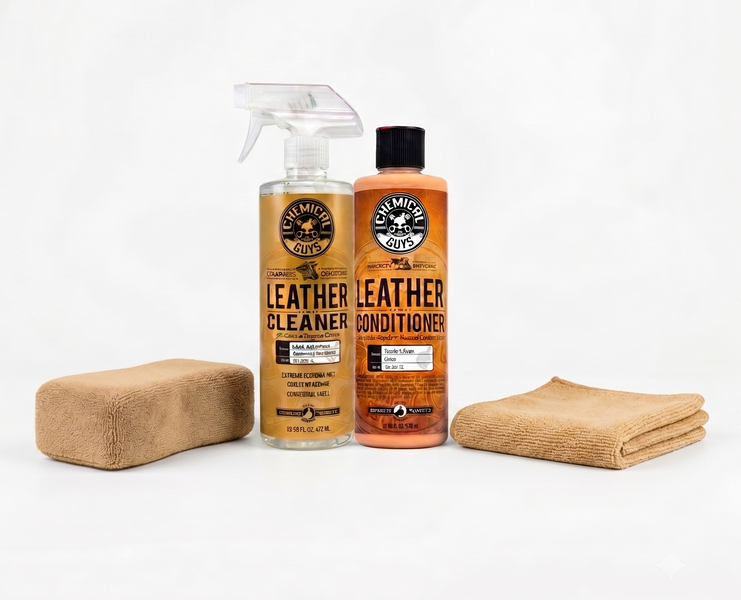
Professional Insight: Most car owners genuinely believe that shiny, slippery leather seats are a sign of being well-conditioned. Detailers know the truth: that gloss is just a layer of body oils, sweat, and dirt clogging the material's pores. True premium leather always has a deep, rich matte finish. You won't know how dirty your interior really is until you do your first 50/50 test with this kit.
We've put together the ultimate foundation that restores your leather to a factory-new state, deeply nourishes it, and protects it from cracking under harsh UV rays.
The Ultimate Care Ritual
Step 01. Detox Cleaning
Mist Leather Cleaner onto a soft leather brush or directly onto your Workhorse towel. Gently agitate the surface of the seats using light circular motions without excessive pressure.
Step 02. Grime Removal
Wipe the area down thoroughly with a clean side of the microfiber towel, scooping up the spent foam along with the extracted body oils.
Step 03. Deep Conditioning
Apply 2-3 drops of Leather Conditioner onto the Workhorse Tan applicator pad. Spread the lotion evenly in a thin layer across the surface and let it sit for 3-5 minutes to fully absorb.
Step 04. The Matte Finish
Take a dry microfiber towel and give the surface a final buff to knock down any unabsorbed excess, leaving behind a perfect OEM matte appearance.
Why does the leather sometimes look greasy or leave a slick residue after conditioning?
This is a classic case of applying too much product. Modern automotive leather is coated with a clear protective sealant from the factory and has a limited capacity to absorb lotions. You must apply the product in a very thin layer. If you notice a greasy shine, simply wipe the surface down thoroughly with a clean, dry microfiber towel a few minutes after application to remove the excess. The leather should feel velvety and matte.
Will this kit help remove blue jeans dye transfer on white or light leather interiors?
No, this basic kit is not designed to strip stubborn chemical dyes (like cheap denim dye) that have already penetrated the structure of the leather's clear coat. However, this kit is absolutely critical for preventing such damage! To protect light interiors from future dye transfer, we highly recommend treating the seats with the innovative Hydroleather Ceramic Leather Protective Coating after cleaning. The ceramic barrier will seal the pores and stop denim dye from biting into the material.
How often should I repeat this care routine?
For daily driven vehicles, the optimal interval for a full cycle (Clean + Condition) is once every 2–3 months. This maintains the moisture balance in the leather and prevents cracking. High-contact areas like the driver's seat and steering wheel (especially on light interiors) can be lightly cleaned once a month.
Are these products safe to use on perforated or ventilated seats?
Yes, they are fully compatible. The golden rule for detailing perforated surfaces: never spray cleaner directly onto the seat and never pour conditioner into the ventilation holes. Always apply the chemicals to your tool first (cleaner on the brush, conditioner on the pad), rub it in slightly, and only then transfer it to the seat. This prevents liquids from clogging the AC ventilation holes.
Can I use this kit on faux leather (eco-leather) or vinyl?
Absolutely. Both formulas are completely safe and effective for delicate natural leather as well as modern high-tech synthetics (eco-leather, vegan leather, vinyl trim). Furthermore, the conditioner is excellent for rejuvenating leather home furniture, jackets, and accessories.